Mathematics, Computers and Zeilberger

October 25, 2008

This piece is a ramble through a collection of thoughts linked to and influenced by the opinions of Doron Zeilberger. It starts with the uncertainty of proof and discusses the importance of computers before concluding with the future of mathematics in the large but finite.
I am never sure how many mathematicians feel this, but I often doubt my own proofs. I find myself certain of some fact, with a chain of reasoning to support it, that, at a later date, fails on some small detail. Only when all the details are worked out do I start to feel a sense of comfort, but even then I fear something will leap out at me and the ideas I thought were quite brilliant fall apart completely.

I therefore always take comfort from Zeilberger’s opinions. He discusses this problem, and actually takes it further:

Mathematics is arguably the most certain body of knowledge, but of course, nothing is certain in this world, and it is a distinct possibility that the Pythagorean Theorem, and even 2+2=4, are wrong, and it just so happened that Nature and/or God programmed the human mind so that it will overlook the gaps in their alleged proofs. Complete certainty (even of death and taxes, and certainly of mathematical facts) is an unreachable ideal, but one can at least try to improve the reliability…

Opinion 91

However he also provides a potential solution:

…we need computers. Computers abhor ambiguity, and trying to teach computers mathematics is also good for us humans, since it forces us to discover hidden ambiguities and resolve them.

Opinion 85

I agree with this entirely. It is so much easier to check if I understand something if I can pull out mathematica or python and actually program it. If my understanding is gibberish I will not see what I expect, but get gibberish back from the computer. It is therefore easy to check if something has failed. Furthemore, I can follow through what happened, and find where it failed (assuming it was not a bug in the code) and thus identify where my intuition was wrong. On the other hand if the output of the code agrees with my expectation, I know that something has gone right. I can now take this further, instead of slowly working through examples for a conjecture by hand I can immediately check them. I even learn mathematics better this way. I probably learnt more about Hyperbolic geometry in constructing the image below than in all the lectures I have attended on the subject (though maybe not in discussions).

A tiling of the hyperbolic plane with 7 equilateral triangles round each point.

A tiling of the hyperbolic plane with 7 equilateral triangles round each point.

To me, therefore, there is an obvious, strong case for using computers for both research and teaching, and encouraging all mathematicians and mathematics students to use SAGE or Mathematica (even though I use it, I do feel that it is a little too expensive). However one can take things further. Maybe computers are not just useful, but essential to the future of mathematics, returning to Zeilberger:

According to this criterion [level of abstraction], most of human mathematics is completely useless. It was developed by humans for human consumption. In order for humans to understand it, it had to proceed in tiny steps, each comprehensible to a human. But if we take the “mesh size” of each step, dA, to be larger, one can do potentially much bigger and better things, and the computer’s dA is much larger, so we can (potentially) reach a mountain-top much faster, and conquer new mountain-tops where no humans will ever tread with their naked brains.

Opinion 72

To me this vision of mathematics is particularly exciting. Mathematics started by studying the behaviour of the small; low numbers and simple equations. The next step was a mathematics of infinity, resting on the observation that in many cases infinity could be used to approximate large numbers, and the continuum to approximate large collections of small things. The problem is that this only holds in “many cases”, it is not true in general. In fact in the growing quantitative study of biology and sociology, made possible by DNA sequences and the data in the internet, it regularly does not hold. We therefore require a mathematics of the large but finite. Computers, with mathematician trainers, provide a way of achieving this. It should be an exciting adventure, after all we have much to learn even in the simplest cases, to quote Tim Gowers:

…there is more to say about the whole question of multiplying large number than you might think…

Joint LMS/Gresham College lecture


Unscheduled post: Why start blogging now?

October 23, 2008

In the way blogs work I read about this WIRED article in John Scalzi’s whatever blog. The basic idea is that blogs are old hat, have gone mainstream and that the cool communication is on Twitter and Facebook. Again, as is the nature of blogs, as I write this many other people are doing exactly the same. Commenting, making similar points with various levels of lucidity, and maybe thinking to themselves “Other people might be doing this as well, but this is different this is personal”.

So, in a different and personal view of this, why I am starting to post entries now? Well firstly, to boost my zeitgeist credentials, I started a first Maxwell’s Demon in 2002-3, so I was there when it was still cool. One thing stopped it being world famous; I did not post anything. I did not feel I had anything to say, and the occasional “I saw my first Segway in the wild today” (I really did, it looked out of place out of a showroom), would probably have bored and the whole thing faded. Alternatively I may have been lucky and avoided this.

I now, however misguidedly, feel that I do have something to say. Maybe the article is right that the best forum for personal stream of consciousness has moved on. Google is, after all, making us stupid, so we need ever faster and briefer forms of communication. Apologies for the cynicism. However I feel that longer considered pieces still have a place and can hopefully rise above the noise to at least one or two people. In addition for me, as I said before writing in even the most unknown of public forums is a way of getting thoughts out of my head so I can move onto the next one!

PS Blogging is a rather ugly word and ideally I would rather not talk about my blog and blogging. Anyone know any good alternatives?


Experiences working with Artists

October 19, 2008

Having put so much time into making the image and setting up this space, I thought it was time to add some more content. Maybe the weekend will be the weekly time to publish, but probably I will be inconsistent.

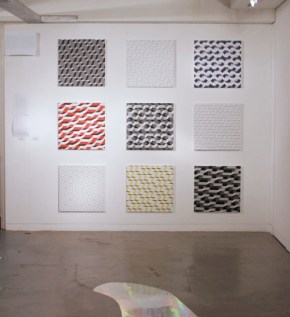
This is a piece I wrote in reaction to working with artists at an art science show at Imperial College London in April 2008. My piece in the show is below:

Surfaces in three and four dimensions

Surfaces in three and four dimensions

Reading the words of Raymond Brownell to describe his mathematical art work, I was struck by an interesting observation. The things that draw me to maths or science art are quite the reverse of many in the field. Instead of seeking the impersonal the perfect the rigourous, I seek to find the personsal, the lucky stroke, the error. When Raymond writes that his style is all about using techniques to make the personal, such as brush strokes, disappear my only reaction is to think of how I want to compose work solely of brushstrokes, the mathematical forms blurred but apparent. Even on a computer I seek ways in which the generating algorithm can introduce subtle changes to what, in the mathematically perfect world should be the same thing.

A related topic occurs in discussions surrounding this show. People have been talking about the nature of the process as apposed to finished work. Science and maths are by their nature an unfinishable process. In general understanding something opens the ways to more questions rather than closing off old ones. Personally I love the feeling of being able to finish a piece of work. It is so much more final for me than the submission or publication of a paper. I understand that art too is a process and in looking at a body of work by a particular artist one can see how ideas developed and were explored. However in my personal work I do get a feeling of finishing when I have produced a work from a particular idea that allows me to move on to the next.

Maybe this is natural as I am coming from maths into art and most are going the opposite way. Therein lies a problem for me, in some ways the work I crave to make is virtuoso, coming from skill, and that skill nearly always takes years to produce. I cringe when I read reviews of Tomma Abts, whose work I adore, and who seems to be a far more skilled painter than I could hope to be in any reasonable time, criticised for her bad or even autistic brushwork. The problem is not only that I am not able to make such strokes, but I am not even sure what they would be.

Maybe I could regret not going to art school, or alternatively take time to enroll in one now. I find two reasons for not doing this. Firstly it would be a disservice to the superb technical and intellectual eductaion that I received instead. I speak in glowing terms about a mathematical education not my own reaction to it. I firmly believe that it is one of the best training for clear thinking available. This education in fact allows me to overcome some of my artistic issues, an inability to draw, by using the power of a computer and then a laser cutter to etch the designs onto canvas, even wet paint. This in fact leads to the second reason. I do not need much of the knowledge an art training provides. That is of course not to say that I do not envy and desire skills such as drawing, merely that I can compensate for my own lack. Time spent learning them would therefore be time not spent learning something else.

I must therefore accept that time, practice combined with informal discussions must do the training for me and I can simply dream of the time when, as I think is the case for Tomma Abts, reviewers of my work have to mention the shoddy brushwork in order to bring balance to an otherwise glowing review.

Apologies for the wordy and slightly rambling style of this short essay. I was inspired to write by listening to a podcast of Stephen Fry and think that I got slightly infected by my poor imitation of his style.


Just what the world needs!

October 17, 2008

Another maths blog.  I am not sure if ‘another’ is entirely appropriate as there are not that many maths blogs, but as there are so many blogs in general maybe it can stand.  Basically I have found myself having thoughts recently, its quite disturbing, and as many of them having nowhere to go but run round my head I decided to get rid of some of them in a public (though almost certain totally unread) place.  Hence this blog.

The thoughts, and thus the major themes of this blog revolve around mathematics communication and mathematics art.  These two will come together naturally as one can use art to communicate mathematics.  

I hope to put one piece up a week, I have a few things written that can be polished and exposed, so I should be able to keep that up for a couple of months at least.  I might also put up half worked out artistic ideas, but my paranoia might keep those under wraps.  I am not sure if that is the paranoia of people thinking my ideas are dull, or the paranoia of people finding them so interesting they nick them.  It feels wrong that I have to suffer both.  

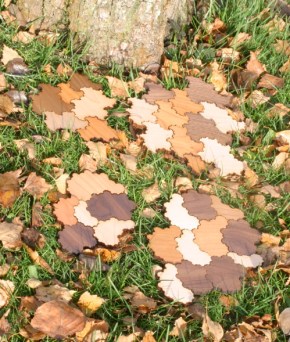
For starters a small puzzle.  It has a real prize!  A set of laser cut wooden tiles like those below to the first person who can tell me what the background of the header is.  Not the image on the left, thats just a flowsnake.

Nautilus and Conch

Nautilus and Conch


Follow

Get every new post delivered to your Inbox.

Join 213 other followers