WoW 5: Finding numbers

April 30, 2009

Apologies for no website last week, as you can see from my last post but one I was a little busy.

This week we have a technical site, Plouffe’s Inverter, one of those that is not necessarily very interesting until you suddenly need it badly! It is a very neat idea, though.  A database of billions of mathematical constants, from the familiar (\pi, e) to the delightfully abstruse (a search for 1.6184135 gives \ln(Kolakoski)^2*Copeland^2*\Gamma(1/24)^2, maybe this is the constant people are really finding when they think they find the Golden Ratio!

So next time you need to find a number you know where to look!

Maxwell Demon: Website of the week

I am handing out awards, the imaginatively titled “Maxwell’s Demon” website of the week:

wowThere is even a prize, £50.  Though I am lazy so the conditions of this are that the winner:

1) Realises they have won.

2) Contacts me.

3) Puts the logo on their site.

Of course 3 is hard to enforce so you could probably take the money and remove the graphical mess.  I will therefore claim that 3 is to ensure that you are indeed the winner.


Unscheduled Post: Subtlety and swine flu

April 29, 2009

The difference between stupid and intelligent people–and this is true whether or not they are well-educated–is that intelligent people can handle subtlety. They are not baffled by ambiguous or even contradictory situations–in fact, they expect them and are apt to become suspicious when things seem overly straightforward.

Neal Stephenson, Diamond Age

The swine flu story is a great test of someone’s subtlety. You have to hold two competing possibilities in your head, both with serious consequences:

1) Nothing interesting is happening…

2) Millions are going to DIE!!!!!!

1 has the obvious cost of fiddling while Rome burns and avoiding doing easy things that make serious improvements down the road. 2 has the problems of panic, societal shutdown, economic issues, etc. Plus for the experts the cry wolf problem, next time people will revert to 1.

The problem is that, at the moment we cannot know quite what will happen, but 2 is a scarily real possibility.

Of course both of these options are better than the media’s version of events. Holding strong versions of both 1 and 2 simultaineously. They both make better stories than subtlety. Saying on the one hand that we are all going to die and on the other that nothing is going to happen. In CNN’s case hyping then accusing twitter of causing panic.

In fact for me twitter has connected me up to excellent information, even though there is plenty of denial and panic as well. With twitter I can choose who to listen to, tuning my own news sources, rather than the limited choice available in the mainstream media.  In particular @bengoldacre, is always a relaible source on stories involving science when it hits the news and on this issue @hexayurt was right on the money, especially with the flucode.  There are many more informed people out there talking sense through this topic.

This is sad as there are many small things that people can do that can make a serious impact on the final outcome. If fact doing these things could possibly prevent it.  The suble fact is that if it is prevented it will be very hard to tell whether what we did was necessary.  Very small reductions in how infectious people are and how many people they come into contact with can have a dramtic effect.  For a non-technical overview of the mathematics of epidemics and disease, there is an excellent article in the online maths magazine Plus.

So in conclusion, spread the flucode and think about things don’t just consume the story you like!


Building Mathematics: Sculpture system No. 5

April 25, 2009

[Update 15/1/10: More pictures (in the snow!) now up]
[Update 16/3/10: A second sculpture built in Newcastle]
[Update 13/5/10: Volcanic background]

Can you get children and young people to build mathematical scultptures in their own time?

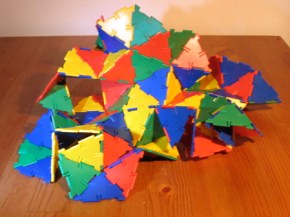
Last week I did. We created this strange object in the lava of a volcanic island on the boundary between America and Europe.

Crowdsourced mathematical art

Crowdsourced mathematical art

The design, Sculpture System No. 5, by Richard Grimes,  and far more details of construction are available here.  The goal is to open this idea to the crowd and see where it is taken, crowdsourcing art.  There is already one other write up. Without further ado, here is my take on events.

If you have never heard of Fab Labs take a look, they are amazing. I came across one by chance on the small island of Heimaey in the North Atlantic.  Luckily for me the guy in charge, Smári McCarthy had a liking for mathematics and asked if I could teach something to the people using the facilities.  When you get an opportunity like that to try to corrupt kids into mathematics you cannot turn it down.  Well I cannot.

The question was what to do? Tilings are nice and produce great images, but they are a little flat. Building something in three dimensions is far more exciting.  The idea that came to me was to make a giant version of Polydron.  If you have not come across this wonderful product look into it now, especially if you are a teacher. It works best if it just left around so people can start to play on their own terms.  Even primary school children can pick it up, play and discover, yet it also holds the interest of many research geometers.

The essence of polydron is regular shapes hinging together. With these you can build anything. I started sketching some ideas in my head, but I am not a natural at building objects.  Luckily one of my inspirations for the polydron idea was on hand. My friend Richard Grimes had been working independantly on similar systems and deltahedra for many years, creating everal sculptural systems, individual objects that can be put together in many different forms. He is also a great craftsman, so he was able to create a design that was simple, elegant and beautiful, not to mention easy to put together. He named it “Sculpture system No. 5″.

The basic tile

The basic tile

The question was what could we build that was artistically satisfying to me, taught some maths and involved people in the design rather than just as donkey work for the construction. As I am writing this in hindsight, of course these are also goals that were achieved!

For constraints we obviously want to minimise the number of shapes used. The simplest shapes are triangles, the polyhedra built from them deltahedra. I decided that twenty was a good number, it is the number you need for a regular icosahedron. The next step was to get people involved. Polydron is the natural tool for this, and as soon as I brought it to the lab it was sucked up, without even being pointed out to people. However to give some freedom to the construction the common maths art fare of highly symmetric figures would not work.  There are not enough of them. In addition, because of the symmetry, they offer the same view from many directions, which is a little boring.  So I went to the other extreme. Build figure with no symmetry. With 20 tiles this is not easy, and spotting symmetries is a great exercise.  So several groups of children took up the project and we had four different designs.  All of which I would have been happy to build.  Before construction everyone voted on the final design.

We then fired up the machines and started cutting the tiles, I will let pictures tell the rest of the story:

Cutting things out

Cutting things out

Painting the tiles

Painting the tiles

A basic hinge

A basic hinge

Construction

Construction

Complete!

Complete!

A ghost in the dark

A ghost in the dark

Next morning

Next morning


Unscheduled Post: Penrose vs Zeilberger

April 22, 2009

Being able to see the searches people use to arrive at Maxwell’s Demon can be quite amusing.  Two hardy souls even managed to come from a search for Mathematics. Just how deep in google do you have to go to find me on that search?

My favourite by far however arrived today:

Penrose vs Zeilberger

I imagine some sort of tag team cage fight so we can occasionally see twistors going up against Shalosh B. Ekhad.


Follow

Get every new post delivered to your Inbox.

Join 203 other followers