Finding Ada: Alicia Stott Boole

March 24, 2010

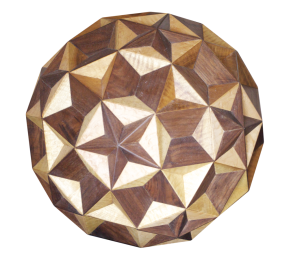
View inside the shadow of the 120-cell.

March the 24th is the birthday of Ada King, Countess of Lovelace. An icon for mathematicians and computer scientists as the first programmer. She developed algorithms that could be run on Babbage‘s analytical engine. For more on the history and relationship between Babbage and Lovelace and some exciting comic adventures twisted round it take a look at 2d goggles.

Ada is also one of the most iconic women in the history of science, so to celibrate that and all the other women who have helped develop science and technology we have “Finding Ada” today. For that I would like to remember a woman whose contribution was not just ahead of its time, it was out of this world: Alicia Boole Stott.

Alicia’s contribution was an intuition that few others have achieved. Though we claim to be able to see in 3d our eyes actually only see two dimensional images. It takes some clever processing in the brain to build a 3d world out of that. In fact even quite simple questions in 3d can be very hard to imagine. For example take the intersection of three cylinders at right angles. What shape is created? I recommend thinking about this for a while before clicking the link! Another problem, that I will not give the answer to, concerns cubes: How can I pass one cube through a small cube without touching or crossing the sides?

I hope that this convinces that seeing 3d is already a hard problem. Alicia did one better. She could almost see 4d. This is not the idea of 4d being 3d space and time. That is really 3+1 d, although it can be useful it also has some problems. For example I cannot have intuition of a rotation that puls the time dimension into the 3 spacial dimensions. Alicia’s intution was for four spacial dimensions. She was able to show that just as there are only 5 regular polyhedra in 3d (tetrahedron, cube, octahedron, dodecahedron and icosahedron) there are 6 regular shapes in 4d. She named them polytopes, a name we still use today. The shapes are:

  • The 5-cell, this has 5 tetrahedra as its 3d faces.
  • The Tesseract or 8-cell, the 4d cube, with 8 cubes as faces. The 3d net of which was used by Salvador Dali in Corpus Hypercubus.
  • The 16-cell, which has 16 tetrahedra as faces.
  • The 24-cell, with its 24 octahedra
  • The 120-cell with 120 dodecahedra
  • The 600-cell, containing a massive 600 tetrahedra.

It is very hard to imagine these shapes but there are two ways that we can bring them back to 3d. The first worked on by Stott-Boole is to take 3d cuts. Without using a computer (it is a lot easier to use an abstract method, once a shape is described) she was able to construct models of 3d sections of all six regular polytopes.

A 3d slice through a 4d stellated polytope made from wood. There are some animations here.

The second method, that in some ways can be more instructive is to take the 3d shadow. Just a the sun casts a 2d shadow of an object in 3d, a light in will cast a shadow of a 4d object on a 3d surface. If you want to glimpse the fourth dimension for yourself. The best way to do it is to build one of these for yourself. This is quite easy thanks to the magic of zometool (and shown at the start of this post). If you want to know more about the life of Boole-Stott, there is an excellent short biography in Theory and history of geometric models by Irene Polo-Blanco.  There is also lots more on 4d geometry at How do shapes fill space?. Finally you can play with the shapes themselves and their rotations in Jenn3d and SceneScreen, both open source projects.


Building Mathematics: The Maker Faire in Pictures

March 16, 2010

[Update 18/3/10 The student from my Communicating Maths course who helped out with the stall over the weekend has put his story up on the course's blog: Maths Students Read the Newspaper .]

Last weekend I had a lot of (exhausting) fun at the Maker Faire in Newcastle. It was a wonderful event so many congratulations to the Centre for Life for laying it on. I was of course there attempting to corrupt people into mathematics, and we had almost more interest than we could handle. Many thanks to both the LMS and the University of Leicester Maths department for their support.

It was also a chance to build Sculpture 2 with Sculpture System No. 5. It will be heading soon to the lair of the JamJar collective somewhere in Leeds:

Enjoy the photos:

Preparing the sculpture...

Before the storm.

Mathematical Models

Daleks invade the 4th dimensions

Penrose tiles

The throng enjoying their chance to build mathematics

Our youngest visitor, fascinated by puzzles and tiling.

A world of zome, mostly built by our visitors.

The bane of our existence: The Tesla coil. Beautiful, but very noisy!

Looking into a zometool model

The first steps of the build

Fixing triangles together.

The finished object

...and again...


The Laws of Gelada (How to be a grad student)

March 3, 2010

Irving Herman‘s Laws for graduates can make good little scientists. How can we make misbehaved big scientists?1 The original Herman rules have Hx numbers my versions are down under Gx.

H1. Your vacation begins after you defend your thesis.

G1. (Force yourself if necessary) to take some time off.2

H2. In research, what matters is what is right, and not who is right.

G2. In research, what matters is good and useful answers, and not who gives them.3

H3. In research and other matters, your adviser is always right, most of the time.

H4. Act as if your adviser is always right, almost all the time.

H5. If you think you are right and you are able to convince your adviser, your adviser will be very happy.

G3. In research, your adviser is probably right more often than you.

G4. Assume your adviser is wrong if you do not agree with him.

G5. If you are right and are able to convince your adviser, everyone gains. 4

H6. Your productivity varies as (effective productive time spentper day)1,000.

H7. Your productivity also varies as 1/(your delay in analysing acquired data)1,000.

G6. Your productivity varies and is not necessarily tied to effort.

G7. Keep on top of routine tasks, but do not be ruled by them.5

GH8. Take data today as if you know that your equipment will break tomorrow.

GH9. If you would be unhappy to lose your data, make a permanent back-up copy of them within five minutes of acquiring them.6

H10. Your adviser expects your productivity to be low initially and then to be above threshold after a year or so.

G10. Realise your productivity will not be high initially. Aim to be more productive, but always allow for variation.7

H11. You must become a bigger expert in your thesis area than your adviser.

G11. You must be more passionate about your thesis area than your adviser.8

H12. When you cooperate, your adviser’s blood pressure will go down a bit.

H13. When you don’t cooperate, your adviser’s blood pressure either goes up a bit or it goes down to zero.

G12. Do not care about your advisors blood pressure.

G13. Cooperate with your advisor. You will get more out of them. They should know a lot that you care about. Thats why you picked them isn’t it?9

H14. Usually, only when you can publish your results are they good enough to be part of your thesis.

H15. The higher the quality, first, and quantity, second, of your publishable work, the better your thesis.

G14. Ideas are only good enough for your thesis when you are proud of them, you can do things with them and you can communicate them to others.

G15. The more interesting you find your results the better your thesis.10

H16. Remember, it’s your thesis. You (!) need to do it.

G16. Remember, it’s your thesis, your research.11

H17. Your adviser wants you to become famous, so that he/she can finally become famous.

G17. Care about your work and find it important. Do not chase fame.

H18. Your adviser wants to write the best letter of recommendation for you that is possible.

G18. Be aware of politics, sell what you do well.12

H19. Whatever is best for you is best for your adviser.

H20. Whatever is best for your adviser is best for you.

G19. Think hard and decide what is best for you.

G20. Listen to authorities (like your advisor), but do not be ruled by them.13


Footnotes

1 BACK TO POST
A few years ago Irving Herman, a physicist at Columbia published a set of laws for graduate students in Nature. To be fair he does say that some of his comments are slightly exaggerated and should not be taken completely seriously. However he also claims these as laws. Which is a very strong rhetoric. On my side my laws can also be slightly exaggerated and are usually highly idealistic, but if you are not idealistic about science you are probably better in a different career anyway.

I came across these recently in Eric Weinstein’s twitter and his comments were the spark and much of the inspiration for this post. I have included his comments on specific laws below. Here is his overall opinion:

New Topic: Thoughts on Prof. Irving Herman’s “20 Laws All Grad Students Should Follow” or “On Being Science ‘Help’ ” as published in Nature. Tweet

I am delighted that colleagues in academe are starting to write down the ‘meta-rules’ of new science that select against strong scientists. Tweet

My goal as taxpayer & scientist is to get you, the young scientist, out of Irving Herman’s dystopia before he can help you become ‘better’. Tweet

and he concludes:

Yet being a scientist isn’t about any of this idiocy. This is about survival in universities & why basic research must reform or leave them. Tweet

2 BACK TO POST
A PhD is hard work, but…Practically taking time off can renew focus, give perspective and thus generate more ideas. More importantly, you are not a robot or slave. Take time off to remember why you are doing this crazy thing.

Herman’s Law 1:”Your vacation begins after you defend your thesis.”
Weinstein’s Excercise:Translate into German without use of a dictionary.

Eric Weinstein Tweet

3 BACK TO POST
It is often better to be productively wrong than unproductively right. Liebnitz/Newton’s Calculus was wrong (and many, most noticably Berkerley spotted this) but those who ignored or were ignorant of this did better maths for 100 years.

4 BACK TO POST
Of course you should treat your advisor with respect, especially for the work that he or she has done. They do have more experience and know more, so they are probably right. However they are also better at arguing than you. Give your intuitions confidence and be persuaded out of them by reasoning not authority.

(“in other matters” your advisor is just another human being, saying that they are mostly right there is crazy!)

3. In research and other matters, your adviser is always right, most of the time.
Just who is this guy? Nature? Physics? Columbia? Anyone?

Eric Weinstein Tweet

Herman’s Law #4. “Act as if your adviser is always right, almost all the time.”
That would be ‘Science … with Benefits’…wouldn’t it?

Eric Weinstein Tweet

5 BACK TO POST
Productive time is essential, but what is it? It is certainly more than time spent in the lab/office. Learn what helps make you productive. Maybe a weekend of surfing leads regularly to great results on a Monday. Routine tasks do need to be done. Keep on top of them so you can relax and think, do not hope you can get PhD students on day to do them, or become a lab assistant for your supervisor!

6 BACK TO POST
Agreement for both of these, it is good to put a little time into insurance against disasters.

7 BACK TO POST
Coming back to the “productivity is complicated” idea. Sometimes you have to get lost, following blind alleys for weeks or months to chase up the great result. It is easy to be productive by finding more routine tasks to do, is that your ambition?

8 BACK TO POST
If you are passionate about your area you will of course think about it and study it more. You should be doing all this for passion and not because your supervisor says that it is interesting.

9 BACK TO POST
Cooperation is a good thing. We do need to work together, to help find the right or useful ideas and communicate them. It is useful to achieve other goals however, not as a goal in its own right.

10 BACK TO POST
Find out what is important to you, what you feel are the big questions. Chase them. Take into account the opinions of others (such as journals) but remember they can be wrong.

11 BACK TO POST
You are paying for this and working very hard on it. Take pride in it, make it your own and do the best job you can. For yourself not your supervisor.

12 BACK TO POST
It is good to show your work achievements and ideas in the best light. Do not however do something for no other reason than it looks good.

13 BACK TO POST
The summary of this post. To be a good scientist is to respect authority while questioning it.

19. Whatever is best for you is best for your adviser.
20. Whatever is best for your adviser is best for you.
So,we may catch Pyonyang yet?

Eric Weinstein Tweet


Recent and current projects

March 1, 2010

I seem to be working on quite a few things at the moment so I thought I would collect a list of them together for those who might be interested.

Firstly the course I am teaching on Communicating Maths at Leicester is going well. The students are going out as teaching assistants to schools for half their credit (with the Undergraduate Ambassador Scheme) and for the other half working on a blog and a wiki. The blog is: Maths Students read the newspaper, inspired by Paulos’ wonderful book A Mathematician Reads the Newspaper. The wiki is developing into a useful collection of mathematics resources.

Sculpture system 5 should soon have its second large sculpture. I am going up to the Maker Faire in Newcastle on the 14th and 15th of March.  Zometool and Polydron will also be on show demonstrating the wonders of building mathematics.  The final sculpture will, all being well,  go on to the Metrocentre in Gateshead.

If you want to hear some more about my thoughts on mathematics, motivations and inspiration check take a look at my two-part interview with Peter Rowlett for “Travels in a Mathematical World”.

Between all this I do find time for research, being involved in founding a new Journal: The Journal of Unpublishable Mathematics, and working on three papers that should be submitted soon, on canonical substitution tilings, the nature of parallelogram tilings and the dynamics of pentagon packing.


Follow

Get every new post delivered to your Inbox.

Join 213 other followers